A stone flicks off a gravel truck on the QEW, there’s a sharp tick against the glass, and by the time you park there’s a small chip in your Toyota’s windshield. A few frosty mornings later, it seems a little larger than you remember.
Not every chip turns into a crack, but small damage is easiest to deal with before it grows. On newer Toyotas there’s another reason to pay attention: the windshield works with the camera behind your rear-view mirror that supports Toyota Safety Sense. Here’s what Toyota owners in Niagara should know about repair, replacement, and getting the right glass.
Toyota Windshield Repair vs. Replacement
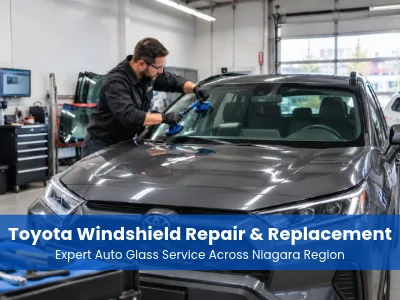
Toyota windshield chip repair is often possible when the damage is small, stable, and in the right spot. When we assess a Toyota windshield, we look at:
- Size and type: A small bullseye or star chip is usually a better repair candidate than a long crack or a chip with legs spreading out from it.
- Depth: Damage that runs deep into the glass is harder to repair cleanly.
- Distance from the edge: Chips and cracks that reach the edge of the windshield tend to spread more easily and usually point toward replacement.
- Driver’s line of sight: A repair can leave a faint mark, so damage directly in front of the driver may be better handled with new glass.
- The camera area: Damage near the camera at the top of the windshield can affect what it sees, so it needs a closer look.
A suitable repair keeps your original windshield in place. Whether repair is the right call depends on the damage itself, which is why we look at it in person first.
Toyota Safety Sense and Windshield Camera Calibration
Toyota Safety Sense (TSS) is Toyota’s suite of driver-assistance features. Toyota Canada lists it as standard on most models, but the package has changed over the years, from TSS-P through TSS 2.0, 2.5, 3.0, and 4.0, and the features differ by model and year. Depending on your vehicle, it may include the Pre-Collision System (PCS), Lane Departure Alert (LDA), Lane Tracing Assist (LTA), Dynamic Radar Cruise Control (DRCC), and Automatic High Beams (AHB).
On equipped Toyotas, many of these features use a forward-facing camera centred at the top of the windshield, working with a radar sensor at the front of the vehicle. The camera reads lane markings and vehicles ahead by looking through the glass.
That’s why Toyota’s repair information calls for the forward camera to be calibrated when the windshield is replaced or removed and reinstalled on applicable vehicles. If the camera isn’t aimed where the system expects, it may not read the road the way it should, and new glass on its own doesn’t confirm that it does.
The exact procedure depends on your model, year, and equipment, so it isn’t identical for every Toyota. Before any replacement, we confirm what your vehicle requires and address the calibration or system check as appropriate.
Choosing the Correct Windshield for Your Toyota
Two Toyotas with the same name can need different windshields. The right glass depends on model year, trim, and installed equipment, so ordering by the badge alone isn’t enough.
- Camera brackets and provisions: On TSS-equipped vehicles, the windshield holds the mounting bracket for the forward camera. Toyota has cautioned that some non-genuine glass may be missing these brackets, or may have a black ceramic border that blocks part of the camera’s view.
- Head-Up Display compatibility: Toyota has offered a Head-Up Display on certain versions of models such as the Camry and Prius. It projects driving information onto the lower part of the windshield, so HUD-equipped vehicles need glass made to work with it. Genuine Toyota parts listings, for example, show a separate windshield for HUD-equipped Camry models. Not every Camry or Prius has a HUD, which is exactly why the trim matters.
- Rain sensors and acoustic glass: Some vehicles have a rain sensor near the mirror for automatic wipers, and some use acoustic glass to reduce cabin noise. Where your Toyota has either, the replacement should match.
Before ordering glass, we confirm your Toyota’s exact year, trim, and equipment.
Toyota Models We Service in Niagara
We repair and replace windshields on Toyota cars, SUVs, trucks, and minivans across Niagara, including:
| Category | Models |
|---|---|
| Cars | Toyota Corolla, Toyota Camry, Toyota Prius |
| SUVs | Toyota RAV4, Toyota Highlander, Toyota 4Runner |
| Trucks | Toyota Tacoma, Toyota Tundra |
| Minivans | Toyota Sienna |
Don’t see your model? We work on other Toyota vehicles too, so just ask.
Niagara Driving Conditions and Windshield Damage
Regular trips on the QEW and Highway 406 mean steady exposure to stones and grit thrown up by trucks and other traffic. Construction zones and gravel shoulders add more loose debris to the mix.
Winter brings its own stress. Freeze-thaw cycles, road salt and sand, and a cold windshield meeting a hot defroster all put pressure on the glass. These conditions can help an existing chip spread, though they don’t guarantee it will. Having a chip checked early is the best way to keep repair on the table.
Contact Star Windshield for Toyota Glass Service
Star Windshield has more than 20 years of experience with windshield repair and replacement in Niagara, serving St. Catharines, Niagara Falls, Welland, Grimsby, Beamsville, Port Colborne, Niagara-on-the-Lake, Stoney Creek, and Burlington. Our mobile service is free, so we can come to your home or workplace.
Whether you need a quick chip repair or a full Toyota windshield replacement, we’ll assess the damage, confirm the correct glass for your vehicle, and explain whether a Toyota Safety Sense calibration or system check applies. Same-day service is often available when scheduling allows, and our work is backed by a 90-day product warranty and a lifetime workmanship warranty.
Call us at 647-509-2154 with your Toyota’s model year and model, and we’ll help you choose the right next step.